
SEO ROI for Local Businesses: How to Measure What It Earns You
Key takeaways
- SEO ROI is the profit search brings in minus what you paid, divided by what you paid, counted in booked jobs and not in rankings.
- Set a baseline, track where each lead came from, then apply the formula over three to twelve months.
- Use profit, not revenue, or the number will look far better than it is.
SEO ROI (return on investment) is what search brings in compared with what you pay for it. For a local business, that shows up as calls, direction requests, form fills and booked jobs, and the math is simpler than most agencies make it sound.
The hard part is not the formula. It is knowing which jobs came from Google Maps and which came from a truck wrap, then staying patient with a marketing investment that builds over months instead of days.
This guide gives you the formula, the numbers to collect and a worked hypothetical example, so you can see the arithmetic. It also answers when SEO is worth it for a small business and when it is not. If you want the price side first, read how much local SEO costs.
01.What SEO ROI means for a local business
SEO ROI is the profit that search brings in, compared with what you pay to earn it. For a local business, that profit comes from booked jobs and sales that start on Google Maps or in organic results. Rankings and website visits are only signals along the way, not the return itself.
In local SEO, the investment is your monthly fee, tools and any SEO content you pay for. The return is the profit from customers who found you through Google.
Rankings and clicks are inputs. Profit is the output. A dentist can double organic traffic and see no change in new patients if the visitors are not local or not ready to book.
So measure the chain from the end back to the start: profit earned, jobs closed, leads received, then visibility. If visibility is moving but leads are flat, the work is not paying yet.

02.The SEO ROI formula with a hypothetical example
Local SEO ROI equals profit from search minus what you paid, divided by what you paid. Profit means revenue after the cost of doing the work, not the invoice total. The result is a multiple of your spend, and multiplying it by 100 gives a percentage. The plumber example below is hypothetical, so swap in your own numbers.
SEO ROI = (profit from SEO − SEO cost) ÷ SEO cost
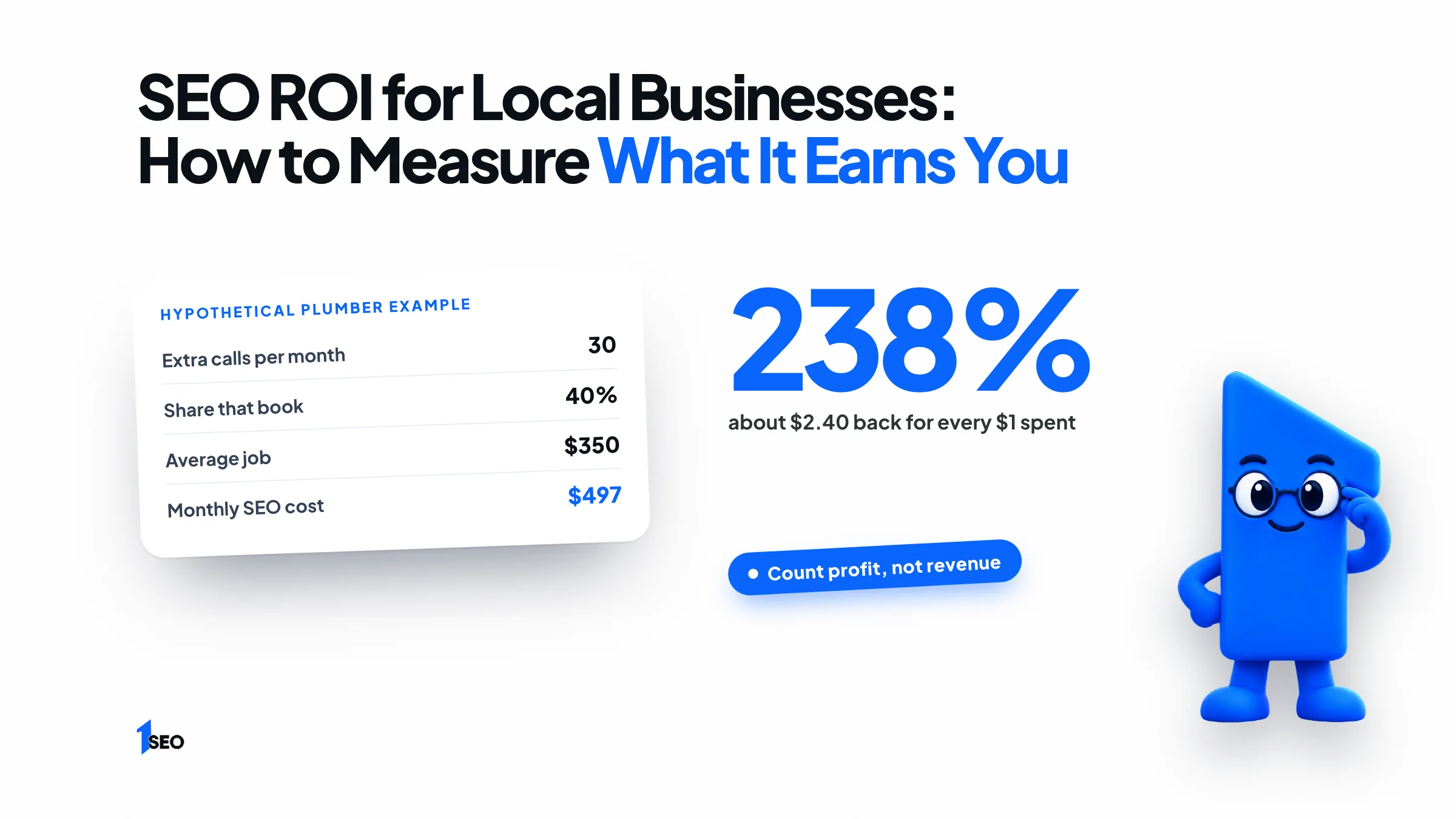
For example, suppose a plumber in Tulsa pays $497 a month for local SEO and, after several months, gets 30 extra calls a month from Google Maps and organic search. Assume 40% of those callers book a job, which makes 12 jobs, at an average job value (the typical invoice) of $350.
Let's say the plumber keeps a 40% margin after labor and parts: twelve jobs at $350 bring $4,200 of revenue, which leaves $1,680 of profit. For example, $1,680 of profit minus the $497 fee leaves $1,183, and $1,183 divided by $497 is about 2.4, or 238%, roughly $2.40 back for every $1 spent.
Revenue is the wrong thing to count. For example, using revenue instead of profit would show 745% for the same month, about three times the true 238%, which overstates what the plumber actually kept.
A useful side number is break-even. Suppose each job leaves $140 of profit: about four jobs a month then cover the $497 fee. For example, a roofer with a $12,000 job at the same margin would cover it with one.
| Input (for example, a plumber) | Example value | Where to find your real number |
|---|---|---|
| Extra calls per month from Google | 30 | Business Profile performance report plus a tracking number |
| Share of calls that book | 40% | Booked jobs divided by calls for the month |
| Average job value | $350 | Average invoice from your accounting software |
| Profit margin per job | 40% | Revenue minus labor and materials, divided by revenue |
| Monthly SEO cost | $497 | Your invoice, plus any tools |
To run your own numbers, use the SEO ROI calculator. For what drives the fee itself, see our guide to local SEO pricing or our local SEO packages.

03.How to measure SEO ROI step by step
Pick a baseline month, count the leads that come from Google, multiply by your close rate, average job value and margin, then subtract what you spent. Repeat monthly. A spreadsheet is enough, as long as you ask every new customer how they found you. Our local SEO report template lists what to track each month.
Step one is the baseline. Before any work, write down your monthly calls, direction requests and form fills from Google. Google's Business Profile performance report counts calls, directions and website clicks. Note that its call number counts taps on the call button, not answered calls. Search Console shows clicks to your site from Google Search.
Step two is attribution. Put a dedicated tracking phone number on your website, add a source field to your contact form, and have whoever answers the phone ask one question: how did you hear about us? Write the answer down, even when it feels awkward.
Step three is the money. Take the leads from Google, multiply by the share you turn into customers, then by average revenue per customer and your margin. Subtract the cost of SEO for the same month.
Step four is time. Look at three-month and twelve-month totals, not single weeks. Local SEO results build on each other, so long-term ROI is the number that matters, and early months often cost more than they return.
- Baseline: calls, direction requests and form fills before work starts
- Source tracking: tracking number, form field, a question at the phone
- Average revenue and margin per customer
- Monthly cost of SEO, including tools and any content you pay for

04.Is SEO worth it for a small business?
SEO is worth it when customers search for what you sell near them, each customer is worth enough to cover a monthly fee, and you have room to take on more work. It is a weaker fit with thin margins, no local demand or a full schedule.
Run a quick test: search your main service and your city. If map results appear and those businesses look busy, demand exists. If referrals already fill your calendar and you cannot take more jobs, more leads will not help yet.
SEO also differs from ads. Pay-per-click stops the moment the budget stops, while a strong profile, good reviews and pages that rank can keep producing leads after the setup work. The tradeoff is time: ads can send calls this week, and SEO builds over months.
Be careful with any provider that promises a position. Google's own guidance says no one can guarantee a number one ranking. A better sign is a provider that explains the work and how you will track leads.
05.Why SEO ROI looks bad in the first months
Early months carry the setup work: audits, profile fixes, new pages and listing cleanup. Rankings need time to respond, so cost comes first and returns follow. A fair schedule is to judge month one on work delivered, month three on visibility and calls, and month twelve on profit.
A good early report shows what was done and which signals are moving: profile views, calls, direction requests and positions for your main keywords. A report that shows only traffic hides whether any of it is local.
Do not stop in month two because the spreadsheet is still red. Do not keep paying for a year with no lead signal moving either. Agree on a review date before you start, and ask what a positive ROI would look like over the long term, within your twelve-month window.

06.Mistakes that make SEO ROI impossible to measure
The common mistakes are no baseline, no call tracking, counting organic traffic instead of leads, using a single month of data and crediting every new customer to SEO. Each one makes the number meaningless, so you cannot compare your provider with other options.
Without a baseline, you cannot say what changed. Without a source for each lead, you will credit SEO for referrals or blame it for slow weeks that had nothing to do with search.
Watch for seasonality too. A roofer after a storm or a heating and cooling (HVAC) company in July will see jumps that are not SEO. Compare the same month year over year when you can. A local SEO audit gives you a clean starting point to compare against.
Conclusion
Find out what your Google leads are worth. Request a free local SEO audit and we will review your profile, website and call data, then show you which numbers to track for your trade.
Our delivery guarantee: Google Business Profile live within 24 hours of receiving access, or your second month is free. The 24 hours start when we receive manager access to the profile and your basic information (hours, services, photos). See the terms.
Frequently asked questions
What does ROI stand for in digital marketing?+
What is a good SEO ROI for a local business?+
Is SEO better than Google Ads for small businesses?+
Can SEO ROI be negative?+
Keep going
What to read next
The serviceLocal SEO auditA full review of your Google Business Profile, website and local competitors, with the fixes in priority order.See the serviceSources & references
About the author
