
A Local SEO Strategy You Can Follow Month by Month for 12 Months
Key takeaways
- A local SEO strategy is an order of work: fix your Google Business Profile first, then build pages and reviews, then listings and links, then measure.
- Google ranks local results on relevance, distance and prominence. You cannot change distance, so the plan works on the other two.
- Nobody can promise a date or a position. Judge progress by quarter, using calls, direction requests and form fills.
A local SEO strategy is a written plan, in a set order, for showing up when nearby customers search on Google. The order matters more than the list of tactics. Fix what Google reads first, then build what proves you are the right choice, then keep it growing.
Many owners do the steps backward. They pay for a blog before the Google Business Profile is correct, or they chase links while half their listings show an old phone number. Say a plumber in Tulsa has the wrong primary category on her profile. A competitor with the right one can outrank her, however many articles she publishes.
This article is the action plan: what to do in months 1 to 12, what to check each quarter, and how to judge whether it is working. If you first need the definition, read what local SEO is. If you want to know why a competitor outranks you, begin with the audit in month one.
01.What a local SEO strategy has to decide
Google says local results are based mainly on relevance, distance and prominence. Relevance is how well your profile matches what someone searches. Distance is how far you are from that person. Prominence is how well known your business is. You cannot change distance, so the strategy works on relevance and prominence.
Google's help page adds one sentence that shapes the whole plan: there is no way to request or pay for a better local ranking. You earn position by being a clearer, better-supported match than the businesses around you.
Whitespark's Local Search Ranking Factors 2026, published November 6, 2025, surveyed 47 local SEO experts on 187 factors. For the map results, they put your primary Google Business Profile category first, the distance between your address and the searcher second, and keywords in your profile name third. For the regular organic listings, a dedicated page for each service came first. This is an expert opinion survey, not Google's formula. It still points the same way: profile first, then pages.
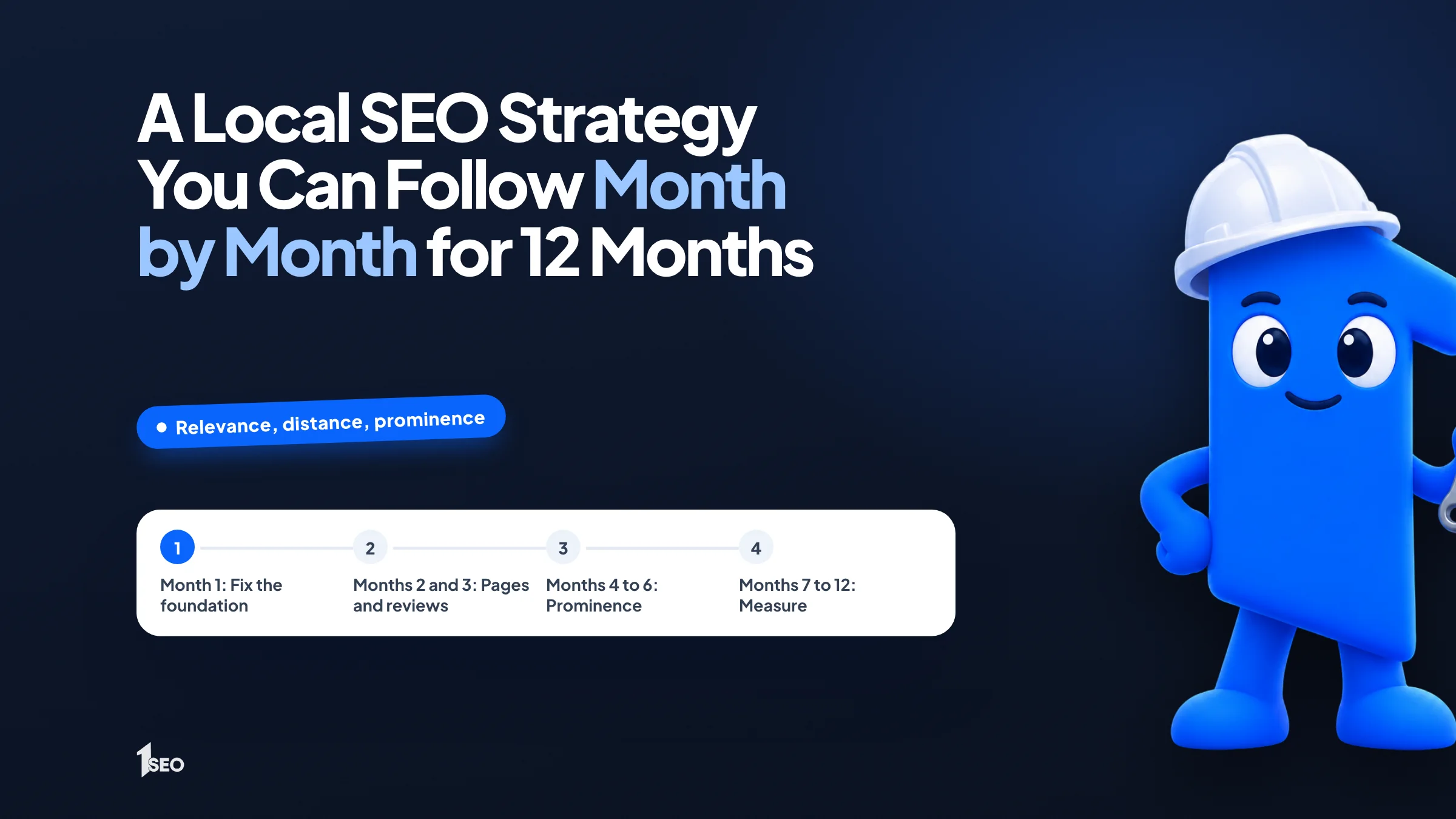
So the plan has four jobs, in this order:
- Get your profile and basic business facts correct.
- Build pages that match the services and cities you want.
- Collect proof: reviews, consistent listings and links.
- Measure what moved, then decide what to do next quarter.
02.Month 1: fix the foundation
Month one is cleanup, not growth. Claim and verify your Google Business Profile, choose the right primary category, make your name, address, phone and hours match everywhere, and check that your site loads well on a phone. Later work will not hold if these basics are wrong.
Start with a baseline. Search your business name and your main service plus your city. Write down what appears: your profile, your competitors, the listings that carry your name. Note every place your phone number or address differs. Also write down this month's calls, direction requests and form fills, so month 12 has something to compare against.
Then work through the profile. Google's guidelines say to choose categories that describe what the business is, to use as few as possible, and not to use categories as keywords. A roofer who also does gutters keeps Roofing contractor as primary and adds a secondary category only if gutters are a real service. Add every service you truly sell, write a plain description, and upload real photos of your work. Our Google Business Profile optimization page lists everything we check.
Your name must reflect your real-world business name. Google says unnecessary information in it is not permitted, so remove taglines and keywords you added. If you serve customers at their location and do not receive visitors, Google says to hide your address and keep your service area to about 2 hours of driving time or less from where you are based.
- Claim and verify the profile, and confirm there is only one for that location
- Set the primary category, then only the secondary categories you really offer
- Match name, address and phone to your website, character for character
- Fix broken pages, slow mobile loading and missing contact details on the site
If you want a second pair of eyes, a local SEO audit does this step for you, and our local SEO audit example shows what one covers.

03.Months 2 and 3: build the pages and the review habit
Once the profile is correct, build one page per core service and one per main city you serve. Pages give Google something to match. Reviews give people a reason to choose you. Do both at the same time.
A service page answers one search. A dentist in Boise needs a page for implants, a page for emergency visits and a page for aligners, not one list of services. Each page says what you do, who it is for, how the process works, how pricing works and how to book. The Whitespark survey above ranks a dedicated page for each service first among the organic factors, which is why this step comes before blogging.
City pages only help if each has something specific to say: the neighborhoods you reach, the jobs you have done, the questions locals ask. Copying one page and swapping the city name wastes a month. Our on-page local SEO service covers how we structure these pages, and local keyword research shows how to pick the words to use.
For reviews, pick a trigger, such as the moment a job is finished, and send the same short request every time with your direct review link. Reply to every review. Google lists replying as one of its tips, and says more reviews and positive ratings can help your local ranking. Buyers read them too: BrightLocal's 2026 survey of 1,002 US consumers, published February 11, 2026, found that 97% read reviews for local businesses and 68% will only use a business rated four stars or higher, up from 55% in 2025. Steps are in how to get Google reviews.

04.Months 4 to 6: build prominence outside your own site
From month four, work on prominence, the part of the plan that happens outside your website. Add consistent listings on the directories your customers use, earn local backlinks from nearby organizations and suppliers, and keep reviews arriving. These signals tell Google that other people recognize your business.
Start with the listings that matter for your trade and your area: your industry directories and your chamber of commerce. The goal is not volume. It is that every place that lists you shows the same facts. Our guides to local citations and NAP consistency explain the basics, and local citation building is the done-for-you version.
Local backlinks, meaning links to your site from other local businesses and organizations, come from relationships you already have. Sponsor a youth team, join your trade association, ask a supplier to list you as an installer, or offer a local news site a useful quote. Whitespark's experts rank the quality and authority of inbound links third among organic factors, so one link from a real local organization beats a bundle of directory links. See local link building if you want help.
Publish helpful content only where it answers real questions, such as pricing, timing and how to choose a provider in your city. Local SEO content covers what is worth writing.
05.Months 7 to 12: measure, expand and protect
In the second half of the year, measure what changed and do more of what worked. Track customer actions (calls, direction requests, form fills), your position for your three most important searches, and your review count. Then expand to new services or nearby cities, and guard your profile against suspensions and unwanted edits.
Look at trends over a quarter, not a week. Expand where the data points. If your emergency page is climbing, add a page for the next service people ask about. If a nearby city already sends calls, give it a proper page. If you open a second location, plan it separately, because each location needs its own profile and page. See local SEO for multiple locations.
Protect what you built. Each month, check your profile for edits you did not make, duplicate listings and reviews that break Google's policies. If your profile is ever suspended, this guide walks through the next steps.

06.A local SEO roadmap by quarter
The roadmap table puts the whole plan on one screen. It shows the order we use and what you can reasonably check at the end of each quarter. It is a sequence, not a promise of dates or positions.
| Quarter | Focus | What to check |
|---|---|---|
| Months 1 to 3 | Profile, categories, contact details cleanup, first service pages and city pages, review routine | Correct profile, first new reviews, first calls from the new pages |
| Months 4 to 6 | Listings and citations, local links, steady reviews | Direction requests and calls for your closest searches |
| Months 7 to 9 | Content for real questions, link building, profile photos | Searches outside your immediate area that now show you |
| Months 10 to 12 | Expansion, monitoring, protection against suspensions and edits | A repeatable monthly routine and next year's plan |
Want the steps on a printable page? Use our local SEO checklist.

Conclusion
Start with month one this week: verify the profile, fix the category and make your contact details match everywhere. If you would rather have it done for you, Ichiban SEO is a remote local SEO agency for US businesses. Tell us your trade and your city through our free local SEO audit, or see our local SEO packages.
Frequently asked questions
How long for SEO to work?+
How much does a local SEO strategy cost?+
Keep going
What to read next
The serviceLocal SEO auditA full review of your Google Business Profile, website and local competitors, with the fixes in priority order.See the serviceSources & references
About the author
