
Local Content Marketing: What to Publish to Win Nearby Customers
Key takeaways
- Local content marketing is publishing website pages and posts that answer real questions from customers in specific places.
- Publish in this order: one page per core service, then pages for your top cities, then pricing and process answers, then project examples.
- Add details only your business can supply, and skip near-copy city pages: Google's spam policies target pages made mainly to rank.
Local content marketing is publishing pages and posts that answer the questions of people in your area, so that Google and customers see you as the business that knows the neighborhood and the job. It is not a blog for its own sake. It is a short list of useful pages tied to the services you sell and the places you serve.
Small businesses often go wrong in one of two ways. They publish nothing, so Google has little to match, or they publish generic articles that any company in any state could have written. A roofer in Nashville gains nothing from a post on the history of shingles.
This guide is a local content strategy in plain steps: which pages come first, what to write about, how to make each piece obviously local and how to keep the effort small enough to sustain.
01.What local content marketing is, and what it is not
Local content marketing is publishing website pages and posts that answer real questions from customers in specific places: service pages, city pages, pricing explanations and project write-ups. It is not generic blogging. A page counts as local only when it holds details that a business in another town could not copy.
Think of three layers. The first is pages that sell: a page for each service and each city you serve. The second is pages that answer: pricing, timing, permits, seasons, how to choose. The third is pages that prove: finished jobs, team profiles and reviews tied to a place.
Google's help page on local ranking names three factors: relevance, distance and prominence. It describes relevance as how well a Business Profile matches what someone is searching for. It describes prominence as how well-known a business is, based partly on how many websites link to it and how many reviews it has. Your pages give Google more to match, and a genuinely useful page is something other sites may link to.
Content will not fix a broken profile. In Whitespark's 2026 Local Search Ranking Factors report, the primary Google Business Profile category is the top-scoring factor for the local pack, and the first website factor on the list, keywords in the landing page title tag, comes in at number 17. Fix the profile first, then add content.

02.A local content strategy in order of priority
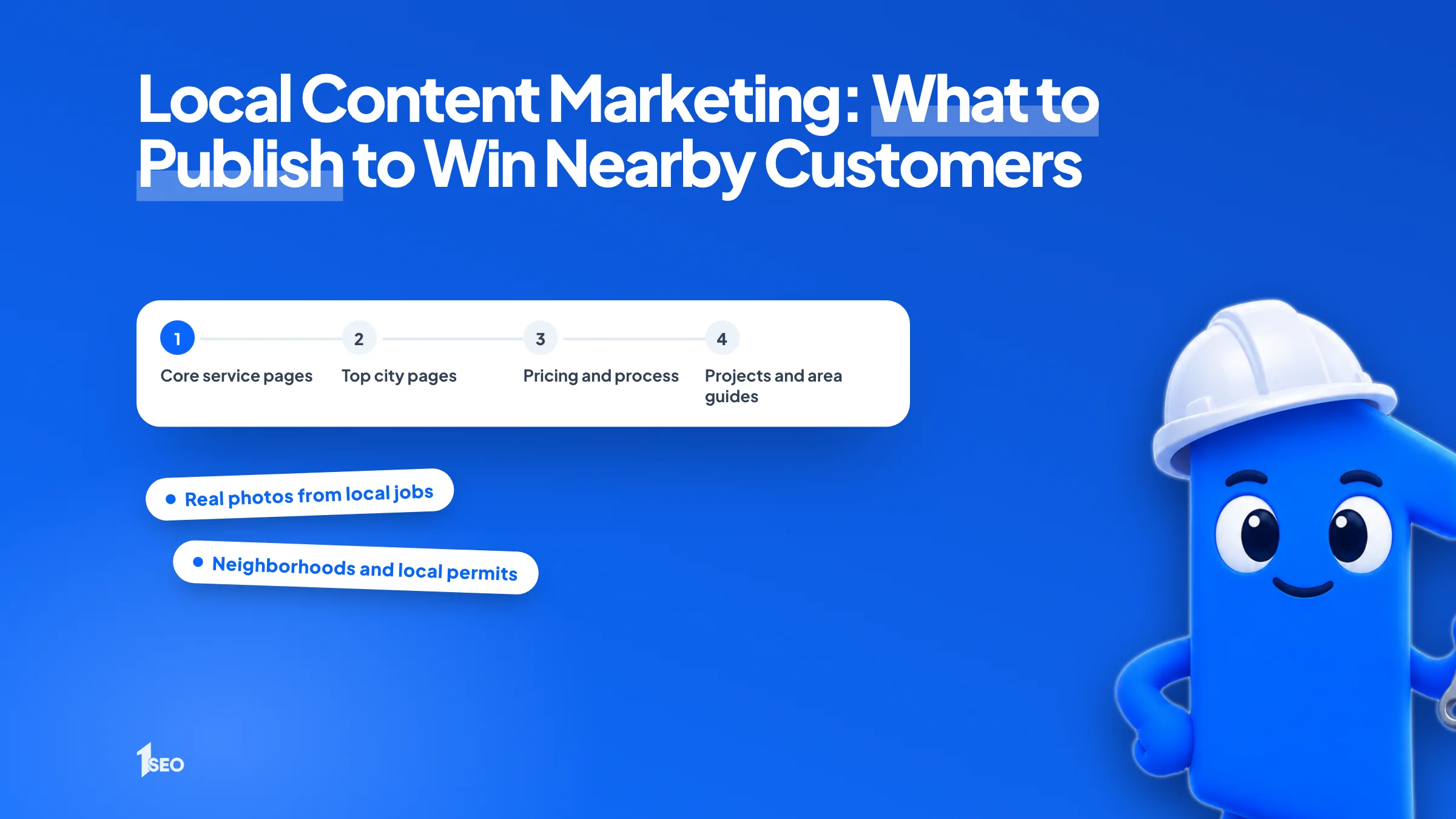
Publish in this order: one page per core service, then pages for your top cities, then pricing and process answers, then project examples and area guides. Each step builds on the one before, and the first two steps give a small business its base.
Service pages come first because they match buying searches. A dentist writes one for implants, one for emergency care, one for clear aligners. Each page covers who it is for, how it works, what it costs or how pricing works, what to expect and how to book. Choose the words each page targets with local keyword research. If you would rather hand the writing off, our on-page local SEO service builds service and city pages.
City pages come second. They help when you have a real reason to be there: staff, a service area or finished jobs. A pest control company serving three suburbs of Jacksonville can give each a page that names local pests, seasons and neighborhoods.
Third, answer the questions that stop people from calling: how much, how long, what happens first, what if it fails. These pages answer the searches people make before they contact anyone.
| Step | Page type | What it does |
|---|---|---|
| 1 | Service pages | Match buying searches for each service |
| 2 | City or area pages | Match searches that name a place |
| 3 | Pricing, process and FAQ pages | Answer questions before the call |
| 4 | Project examples and local guides | Show experience in the area |

03.How to make content genuinely local
Add details only your business can supply: the neighborhoods and streets you work on, local rules and permits, seasonal problems, real photos from local jobs and quotes from nearby customers. Generic text with a city name swapped in gives Google and customers nothing they could not find on any other page.
A water damage company in Houston can write about hurricane season and slab foundations. A landscaper in Scottsdale can write about desert plants and watering rules. Those details come from your daily work, and a distant competitor cannot easily fake them.
Use real photos with the location in the description, and add reviews from that area. If you finished a kitchen remodel in a particular neighborhood, a short write-up of the job with before and after pictures is better than a paragraph of claims.
Do not multiply pages to cover more places. Google's spam policies list as doorway abuse "multiple domain names or pages targeted at specific regions or cities that funnel users to one page". They define scaled content abuse as many pages generated mainly to manipulate search rankings instead of helping users, no matter how they are created. A city page earns its place when it says something true about that city.
Check each page with one question: could a competitor in another state publish this unchanged? If yes, add a local detail or do not publish it.
- Name the neighborhoods, streets and landmarks you really work around
- Mention local rules, permits, weather and seasonal problems
- Use your own photos from local jobs with accurate descriptions
- Quote local customers, with their permission
- Link each page to your Google Business Profile and to related pages
04.Content that supports your Google Business Profile
Your profile and your website should support each other. Link the profile to your most relevant page, keep services and descriptions consistent with your site, and use profile photos and updates to show recent work. Do not put links in the profile description, because Google's guidelines do not allow them.
Google's guidelines for representing your business say that no links of any type are allowed in the business description, and that it should not focus on promotions, prices or sales. Keep the description plain and factual, and let the website field in the profile do the sending.
Photos and short updates are your content inside the profile. Google's tips for a stronger profile include responding to reviews and adding photos and videos. A photo of a finished job each week, a seasonal reminder or a note about holiday hours is easy to keep up.
Reviews belong in this plan too, because Google counts how many a business has as part of prominence. Ask happy customers to leave one, using the steps in our guide on how to get Google reviews.
05.Keeping local content realistic and measurable
Aim for a calendar you can keep: one new useful page or post a month beats ten rushed pages in a week. Check whether new pages earn impressions and clicks in Google Search Console, and update old pages before writing new ones.
The Search Console performance report counts impressions, which is how many times your site appeared in search results, and clicks, which is how many times a user clicked through. Those two numbers tell you whether a new page is being shown and whether anyone chooses it.
A simple rhythm works. Month one, a service page. Month two, a city page. Month three, a pricing answer. Then repeat, and revisit the pages with the most impressions to improve them.
Watch for pages that get impressions but no clicks, which can point to a weak title, and pages that get clicks but no calls, which can point to a weak next step. Fix those before publishing more.
Conclusion
Start with one service page this month, make it specific to your area, and measure it in Search Console. Ichiban SEO is a remote local SEO agency for US businesses. See our pricing or ask for a free local SEO audit.
Frequently asked questions
Do I need a blog for local SEO?+
How many city pages should I create?+
Can I use AI or a template to produce many local pages?+
Can content help me appear in the map results?+
How long before local content shows results?+
Keep going
What to read next
The serviceLocal SEO auditA full review of your Google Business Profile, website and local competitors, with the fixes in priority order.See the serviceSources & references
About the author
