
What Is Local SEO and How Does It Bring Customers to You?
Key takeaways
- Local SEO improves how your business shows up in map results, local listings and Google Maps.
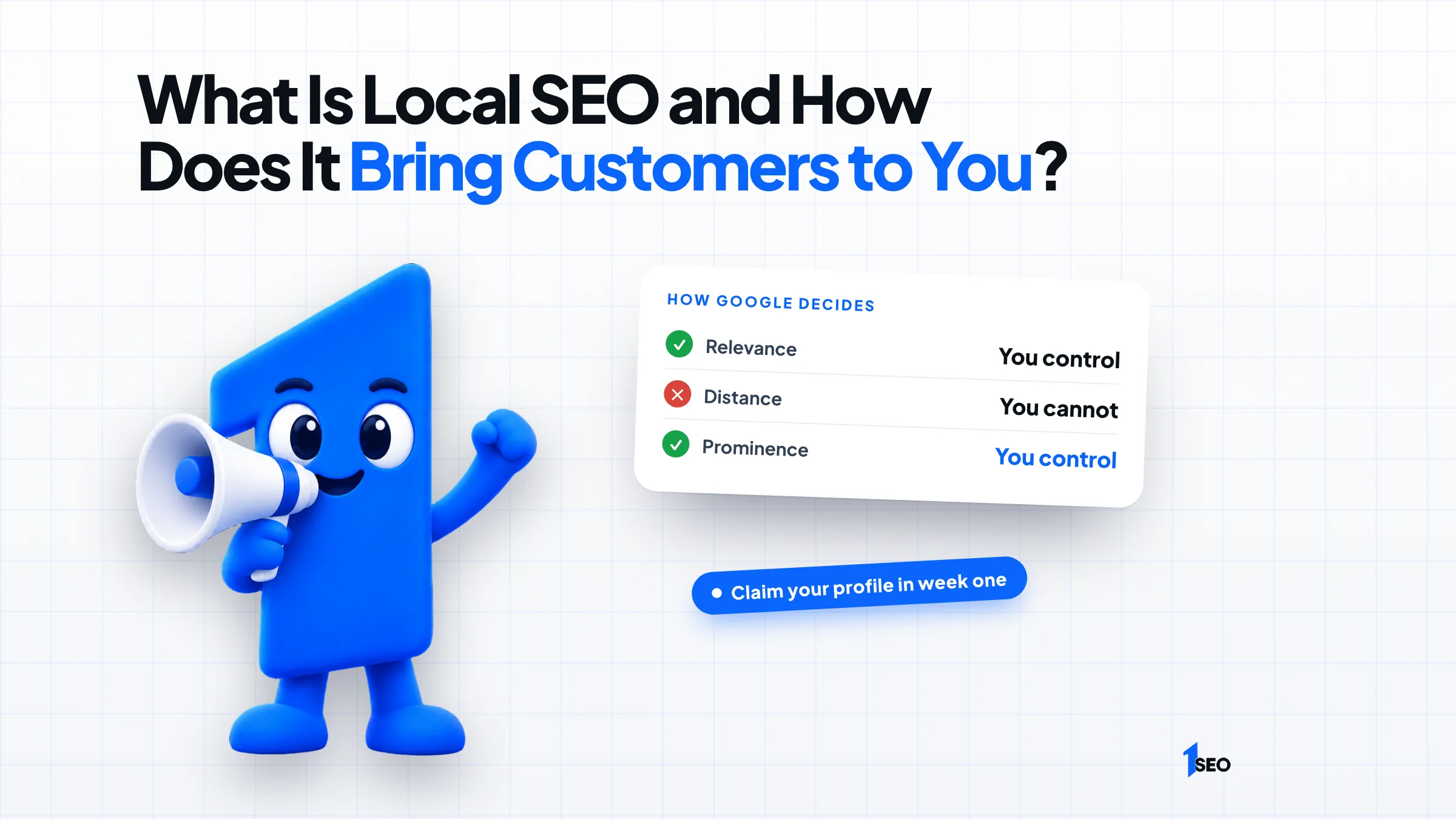
- Google says local results rest on relevance, distance and prominence, and you control two of the three.
- Week one is claiming your profile, fixing the basics and asking recent customers for a review.
What is local SEO? It is the work of making your business easy for Google to show when someone nearby searches for what you sell. Think of a search like plumber near me, dentist open Saturday or best tacos in Boise. Local SEO helps decide which few businesses appear first, and whose phone rings.
It is different from general SEO. A national website tries to rank in search engines for a topic anywhere in the country. A local business needs to be found by people within driving distance.
This beginner guide goes in order. First what Google looks at, then what experts say matters most and which parts you control. Next come three basic steps, how local SEO differs from regular SEO, and what it costs. No tools or technical background required.
01.What is local SEO in one paragraph?
Local SEO is the practice of improving how your business appears in Google results tied to a place: the map results, local listings and Google Maps. It combines four things: a complete Google Business Profile, a website that matches local searches, customer reviews and consistent business information across the web. Together they make up your online presence for nearby customers.
A search has local intent when Google guesses the person wants something nearby, even if they never type a city. Searches for a plumber, a dentist, a restaurant or a locksmith usually trigger it.
The goal is simple. When that search happens, your business is shown, looks trustworthy and is easy to contact.
02.How Google decides which local businesses to show
Google says local results are based mainly on relevance, distance and prominence. Relevance is how well your profile matches the search. Distance is how far you are from the searcher. Prominence is how well known you are, which includes your reviews and how many websites link to you.
These three factors come from Google's help page on improving your local ranking. The same page says: "There's no way to request or pay for a better local ranking on Google." So nobody can sell you a position.
You cannot change distance, because customers are where they are. You can change relevance and prominence. Relevance comes from complete, accurate profile details: your business type, hours, services and a website that matches what people type. Prominence comes from earning reviews and links over time. Google also says more reviews and positive ratings can help your local ranking.
Google says these factors are weighed together, so no single one decides the result.

03.What local SEO experts say matters most
Whitespark's 2026 Local Search Ranking Factors report, published November 6, 2025, surveyed 47 local search experts on 187 factors. For the map results, the primary Google Business Profile category came first. For the regular listings below the map, a dedicated page for each service came first.
This is an expert opinion survey, not Google's own formula. Treat it as a guide to where beginners should look first.
| Rank | Map results (local pack and Maps) | Regular local listings |
|---|---|---|
| 1 | Primary Google Business Profile category | Dedicated page for each service |
| 2 | Distance between searcher and business | City or neighborhood keywords in your content |
| 3 | Keywords in the business name on your profile | Quality of links pointing to your website |
| 4 | Physical address in the city searched | |
| 5 | Business open at the time of the search |
Two lessons stand out. Your profile choices, especially the category and hours, weigh heavily for the map. Your website matters most for the listings below it, and it needs a real page for each service.
One caution. Stuffing extra keywords into your business name breaks Google's rules. They say the name should reflect your real-world name.
04.The parts of local SEO you can actually control
You control five things: your Google Business Profile, your website pages, your reviews, your listings on other sites and the links pointing to you. A beginner should start with the profile, because it feeds the map results directly and is free to fix.
The Google Business Profile is the card that shows your name, category, hours, photos, reviews and buttons to call or get directions. Your website supports it with a page for each main service and each city you serve, your real address or service area, and a clear next step. Reviews work as a ranking input and as sales material. Listings in local directories and links from other local sites show that the web agrees you exist.
- Google Business Profile: category, services, hours, photos, description
- Website: service pages, city pages, fast mobile loading, contact details
- Reviews: steady new reviews on Google, with a reply to each one
- Listings: the same name, address and phone number (NAP consistency) in every local directory
- Local backlinks: mentions from local organizations, suppliers and news
Each piece has its own guide. Start with how to choose Google Business Profile categories, how to get Google reviews, what local citations are and why name, address and phone consistency matters.

05.Local SEO tutorial: three basic steps
In week one, start with three basic steps: claim and verify your Google Business Profile, set the correct primary category with accurate hours and phone number, and ask your most recent happy customers for a review. These steps cost nothing and cover the inputs that matter most to beginners.
Step 1, claim and verify: search your business name. If a profile appears with a prompt to claim it, claim it. If none exists, create one and complete the verification Google asks for. Our guide on how to claim your Google Business Profile walks through it.
Step 2, set the basics: choose the category that matches your main revenue, then add only the secondary categories you truly serve. Use your real business name, with no keywords added. Check that your website shows the same name, address and phone number as your profile. Service-area business? If customers never visit you, hide your address and set a service area. Google says the service area should generally not extend beyond about two hours of driving time, according to its guidelines for representing your business.
Step 3, build trust: add real photos of your storefront, team and finished work. Then send a short, friendly review request with your direct review link to your most recent happy customers, and repeat it after each good job.
For the full plan beyond these basics, read our local SEO strategy guide or use the local SEO checklist.

06.Local SEO versus regular SEO
Regular SEO, also called traditional SEO, tries to rank web pages in organic search for topics regardless of location. Local SEO ranks a business for searches tied to a place. It relies on the Google Business Profile, reviews and distance as much as on the website. A local business usually needs both, but should start with local.
A national store competes with the entire country for a keyword. A roofer in Tampa competes only with roofers who serve Tampa customers. That smaller field gives a local business a clearer target.
| Regular SEO | Local SEO | |
|---|---|---|
| Where it shows | Standard blue-link results | Map results, local listings, Google Maps |
| Who you compete with | Any site on the topic | Businesses near the searcher |
| Key asset | Website content and links | Google Business Profile plus reviews |
| Search example | how to fix a leaking pipe | plumber near me |
To see how the map results work in detail, read our guide to the Google map pack. For the plan that ties everything together, see local SEO strategy.
07.What local SEO costs and what to expect
You can do the basics yourself for free, with your time. If you hire help, Ichiban SEO's Ascension plan is $497 per month and Domination is $897 per month, with no setup fee. Foundation, a website build, is a one-time $1,490. Nobody honest can promise a specific ranking, because Google does not sell positions.
Results depend on your competition and your starting point. Say a plumber in Tulsa has 12 reviews and an unfinished profile. Finishing the profile and collecting reviews are the first fixes, and how fast they pay off depends on the other plumbers in town. For a full breakdown of what drives price, see what local SEO costs or compare our local SEO packages.
Our delivery guarantee covers speed, not rankings: Google Business Profile live within 24 hours of receiving access, or your second month is free. As soon as you give us access to your Google Business Profile, we optimize it within 24 hours: categories, description, services, hours, attributes and photos, all published. If we miss the deadline, your second monthly fee is waived. The 24 hours start when we receive manager access to the profile and your basic information (hours, services, photos). Full terms are on the pricing page.
Conclusion
Not sure where you stand today? Ichiban SEO works remotely with US local businesses. Ask for a free local SEO audit. We will show you the first three fixes worth making for your profile.
Frequently asked questions
What is local SEO in simple terms?+
Do I need a website for local SEO?+
How long does local SEO take?+
Can a service business without a storefront do local SEO?+
Does local SEO help in ChatGPT and other AI search?+
Keep going
What to read next
Sources & references
About the author
