
The Google Map Pack Explained: What It Shows and Who Appears
Key takeaways
- The Google map pack is the map and short list of local businesses Google shows for searches with local intent.
- Per Google's help page, local results rely mainly on relevance, distance and prominence, so two people can see different lists for the same search.
- You can only appear through a Google Business Profile, not through your website alone, and Google says you cannot pay for a better local ranking.
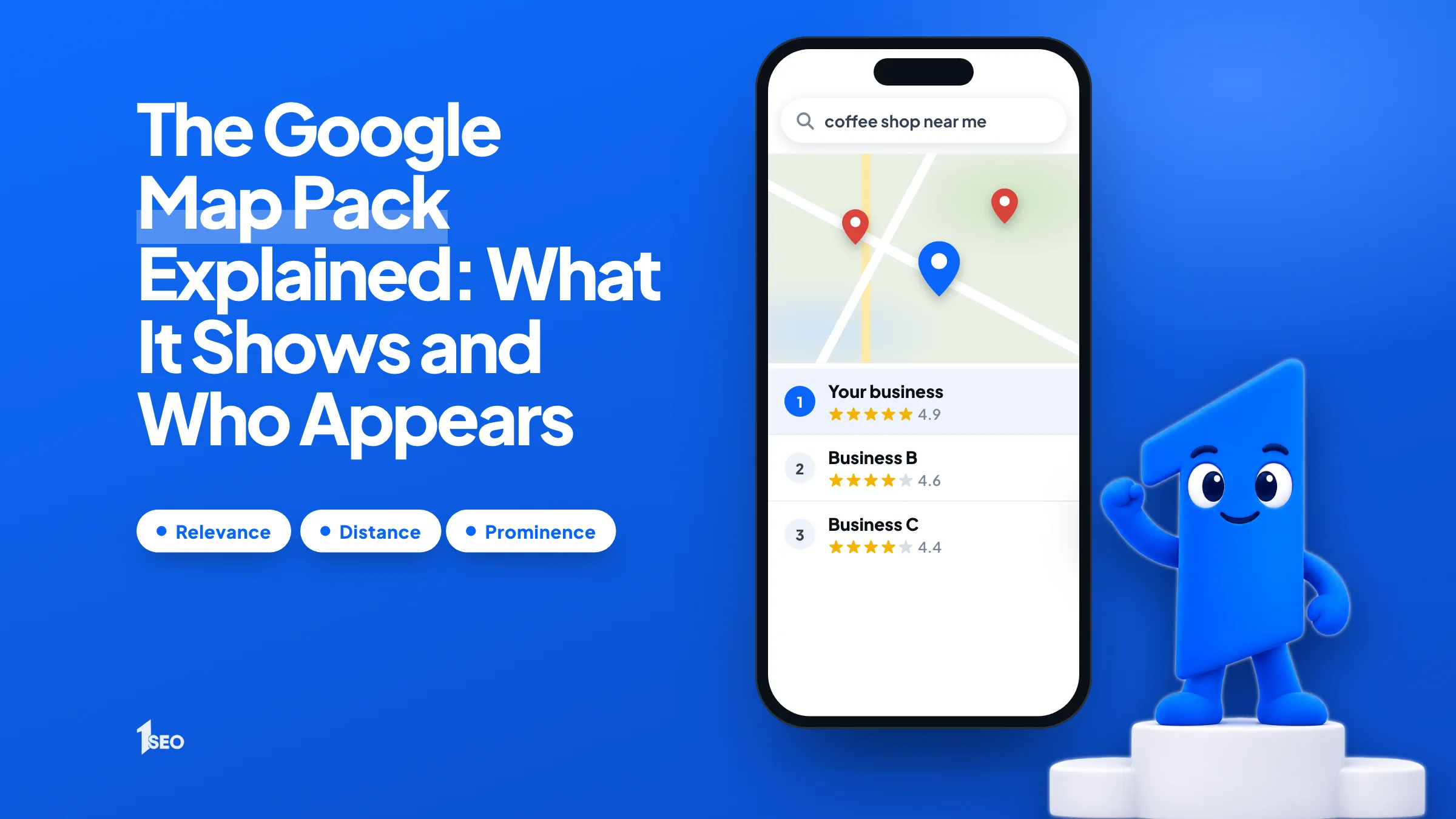
The Google map pack is the block of results that appears when someone searches for a local business: a small map with a short list of businesses beside or under it, each with a star rating and buttons to call or get directions. It sits above or between the regular website results.
Searchers also call it the local pack, the 3-pack or the Google Maps pack. The names mean the same thing: a set of Google Business Profiles pulled into the search page for a query with local intent.
This article explains what the pack shows, how Google picks who appears, why two people see different lists and how the pack differs from the regular results and the Maps app. When you want to move up, the next step is our guide on how to rank higher on Google Maps.
01.What the Google map pack is
The Google map pack is a map with a short list of local businesses that Google shows on the results page when a search has local intent. Each listing comes from a Google Business Profile, not from a website page. The pack usually shows three listings, though Google decides the format and it varies by search and device.
Search for emergency plumber, dentist open now or coffee shop near me and Google can answer with a map before any website. A search such as how to fix a dripping faucet is informational, so Google has little reason to show nearby businesses.
People also call it the local pack, the 3-pack or the Google Maps pack. The names describe the same block of results. Local SEO vendor Localith describes the same three-listing layout in an August 2026 guide.
Your website is not what appears there. Your Business Profile is. Google's guidelines say a business can have a profile if it has a physical location customers can visit or travels to customers where they are. Virtual offices and businesses with no real customer contact are not eligible for a profile. Without a profile, you have nothing to show in the pack.

02.What each part of a map pack listing shows
Each listing shows the business name, star rating, review count, category, hours and buttons to call, get directions or visit the website. Most of it comes straight from the Business Profile, its reviews and photos. Every field you fill in is something a searcher reads before deciding whether to click or call.
The name and category tell a searcher what you are. The stars and review count tell them what other customers thought. The hours tell them whether you can help right now.
Because the pack is built from the profile, an error there shows up everywhere. A wrong phone number, hours that say closed when you are open, or a category that does not match your main service all reach the searcher before your website does.
- Business name and primary category
- Star rating and number of reviews
- Open or closed status and hours
- Call, directions and website buttons
- Photos from the profile
03.How Google picks who appears in the map pack
According to Google, local results rely mainly on three things: relevance, distance and prominence. Relevance is how well a profile matches the search. Distance is how far the business is from the searcher. Prominence is how well known the business is. Google adds that there is no way to request or pay for a better local ranking.
Google's own help page says prominence also depends on how many websites link to your business and how many reviews you have, and that more reviews and positive ratings can help your local ranking.
Whitespark's Local Search Ranking Factors 2026 report surveyed 47 local SEO experts on 187 factors. For the map pack and Maps, they put the primary category first, the distance between your address and the searcher second and keywords in the profile name third. A high Google rating and the number of reviews with text also made their top ten. This is an expert opinion survey, not Google's formula.
Service-area businesses face a tradeoff. Google's guidelines say a service-area business should hide its address from customers. Whitespark's survey also lists a visible profile address in its top ten. If you work from home, follow Google's rule and put your effort into the factors you control, such as category, reviews and complete profile details.
04.Why two people see different map packs for the same search
Two people searching the same words can see different packs because Google measures distance from each searcher. If a searcher does not share a location, Google uses what it knows about where they are. The words in the search, and whether a business is open at that moment, can also change who shows up.
Say a Tulsa plumber searches "plumber" while standing in the shop. The listing may look strong because the plumber is standing next to it. A homeowner five miles away can see a different group of three. That is why a check from your own office tells you little.
Wording matters too. Roofer, roof repair and roofing contractor can return different packs, because each one matches categories and services a little differently. Whitespark's survey also lists being open at the time of search among its top ten factors.
The fix is to check from several places. Search your main services from different points in your service area, in a private browser window, and write down who appears. In a May 2026 NP Digital survey of 180 local businesses, 59 percent said they do not track Map Pack visibility at all, so a simple monthly check is more than most surveyed businesses do.

05.The map pack versus regular results and the Maps app
The map pack, the regular results and the Google Maps app are three surfaces. The pack and Maps draw on Business Profiles. The regular results draw on website pages. A business can show up in one and miss the others, so each surface needs its own work.
Below the pack sit the regular results, where a well-built service page or city page can still earn a click. Many businesses appear in both places.
Google Maps is where people search for places directly. It uses the same profiles, so work on your profile helps the pack and Maps together, while work on your website helps the regular results.
| Surface | What it shows | What feeds it |
|---|---|---|
| Map pack on the search page | Map plus a short list of businesses | Google Business Profiles |
| Regular search results | Website pages | Your site, links and content |
| Google Maps app and site | Longer lists, filters, routes | Google Business Profiles |
Paid ads are a separate placement, and Google states that paying cannot buy a better local ranking. For the paid side, see our guide to Google Local Services Ads.
06.What to do about the map pack next
Start by checking how you appear: search your main services from several spots in your service area and note who shows up. Then fix the Business Profile basics, since the pack is built from them. After that, work on reviews and local pages to look more relevant and more prominent.
If you do not appear at all, check three things in order: the profile is verified, the primary category matches the search, and the profile is not suspended or duplicated. Our guide on why a Google Business Profile is not showing walks through each one. The free Google Business Profile audit tool checks your category, reviews and hours.
If you appear but sit below competitors, the gap is usually in reviews, categories or distance. Our guide on how to rank higher on Google Maps covers the steps in order, and how to get Google reviews covers the review side. For the full plan across a year, see our local SEO strategy.
If you would rather hand the profile work off, our Google Business Profile optimization service covers it.

Conclusion
The Google map pack is a short list of local businesses built from Google Business Profiles, and who appears depends on relevance, distance and prominence. Ichiban SEO is a remote local SEO agency for US businesses. We can check how you appear across your service area and tell you what is holding you back. Start with a free local SEO audit.
Frequently asked questions
How do I get into the map pack?+
Can I pay to be in the Google map pack?+
Why am I not in the map pack for my own business?+
What is a Google 3-pack?+
Keep going
What to read next
The serviceGoogle Business Profile optimizationEvery field, category, photo and post set up to help you show up in the map pack.See the serviceSources & references
About the author
