
The Google Review Policy in Plain English for Business Owners
Key takeaways
- Google bans fake, incentivized, gated and conflicted reviews, but you can ask real customers for reviews.
- Google screens reviews against its policies, doesn't restore ones removed for violations, and lets you report them from your profile.
- The FTC's rule on consumer reviews, effective October 21, 2024, adds federal penalties for fake or suppressed reviews.
The Google review policy decides which reviews stay on your Business Profile and what you can do when you ask customers for feedback. Most owners read it only after a review vanishes or a fake one refuses to go away.
The short version: a review has to describe a real experience, nobody can be paid or pressured to write one, and nobody can steer a rating up or down. A federal rule from the Federal Trade Commission (FTC) adds penalties on top.
01.The Google review policy at a glance
Google bans fake engagement, incentivized or biased reviews, unusual patterns of review activity, impersonation, misrepresentation, off-topic rants, and advertising inside a review. A review has to describe a real experience at that location. Accounts that break the rules can be suspended or terminated.
Google's Maps user-contributed content policy tells users to post only content based on their own experience, or questions about experiences, at a specific place. General, political or social commentary and personal rants don't belong. Reviews can't pose as another person or organization, describe goods or services in a false or misleading way, or work as ads, which includes contact details and links.
Two categories matter most to owners. Fake engagement covers reviews that were paid for, in cash or in kind. Rating manipulation covers reviews prompted by a business incentive and content showing unusual volumes or patterns of review contributions that suggest someone is trying to move a place's rating.
When Google decides what to do with an account, the policy says it looks at the content, the account information, what the user did and patterns of harmful behavior.

02.What the policy lets you do when you ask for reviews
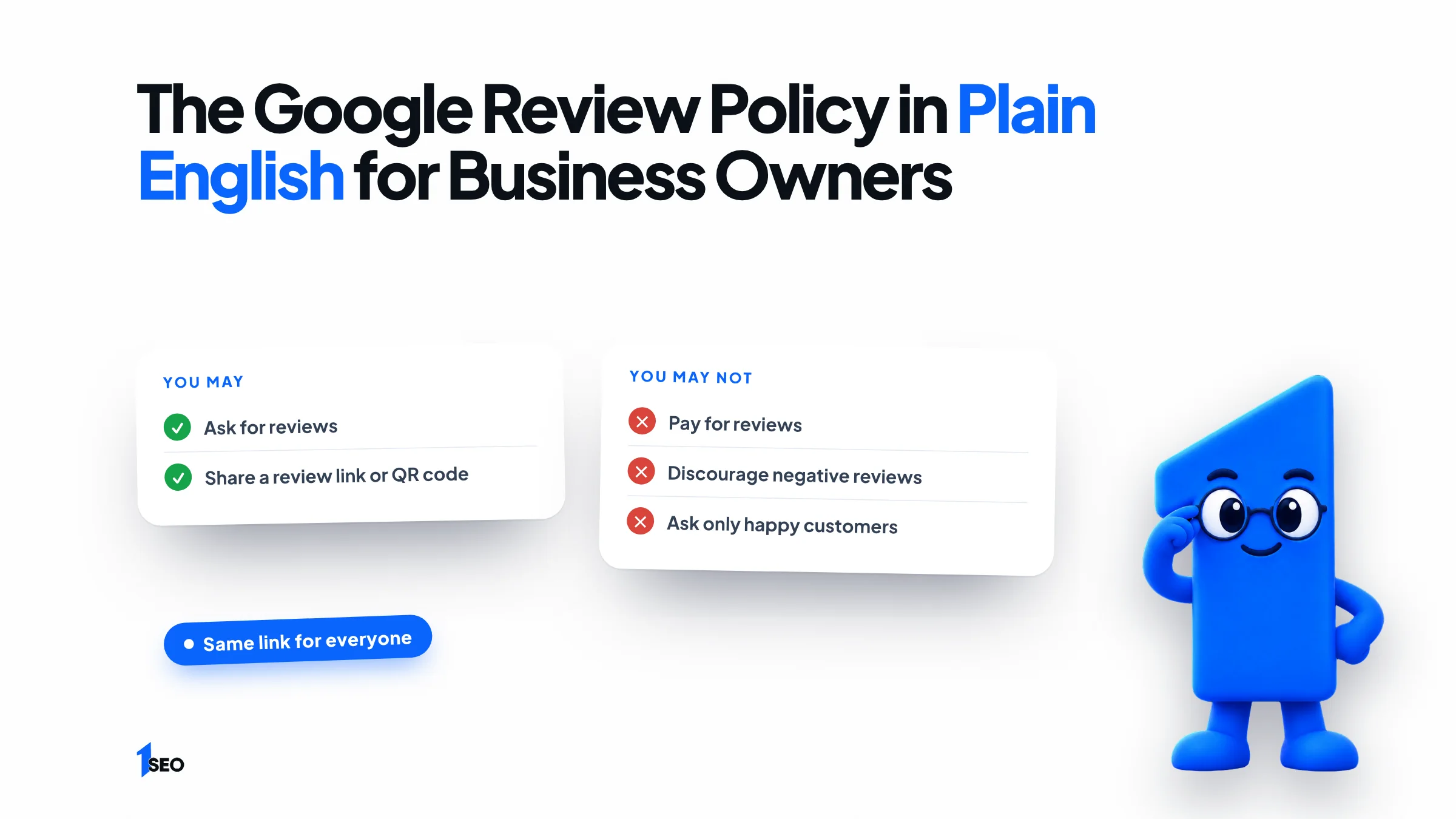
You can send review requests to customers, and Google lets you share a link or QR code to make it easy. You can't offer payment, discounts or free goods for a review, discourage negative reviews, or ask only your happiest customers. Customers must be signed in to a Google Account to post.
Google's help page for business owners says you can ask customers to visit a Google link or scan a QR code. It classes incentives such as free or discounted goods or services, offered in exchange for reviews, as fake and misleading content. Rewards for changing a review or removing a negative one are covered too. The content policy adds payment to the list.
Review gating means screening customers first, sending happy ones to Google and unhappy ones to a private form. The content policy says merchants shouldn't "discourage or prohibit negative reviews, or selectively solicit positive reviews from customers." Gating does exactly that, so send every customer the same link.
For wording, timing and follow-ups, see how to get Google reviews. The Google review QR code generator builds the link and the code.

03.Who can't review your business: conflicts of interest
Google doesn't allow reviews written from a conflict of interest. The policy says that may include current or former employment, a contractual or consulting relationship, competitors, and family members. Reviews like these can be removed, and several of them in a short time can also look like an unusual pattern.
Say a plumber in Tulsa asks her office staff, her cousin and two former technicians to post five-star reviews. Every one of those people has a connection that Google's content policy lists as a possible conflict of interest. Each review can be removed, and five arriving in the same week fits the policy's description of unusual volumes or patterns.
The same policy says merchants shouldn't require or pressure customers to leave ratings or write reviews while on the premises, and shouldn't ask that specific content be included. The same goes for asking staff to collect a set number of reviews or reviews with specific content.
A written rule helps: no one on the payroll, no relative and no vendor reviews the business, and no one tells a customer what to write.

04.How Google screens and removes reviews
Google checks reviews against its policies, and some checks take a few days, so a new review can appear late. Reviews removed for violations aren't restored. Google may also temporarily turn off user-created content, including reviews, in certain situations. If you spot a violation, you can report it from your profile.
Google's page on missing or delayed reviews says reviews are checked to make sure they follow its policies and that reviews removed for policy violations won't be restored. It also says Google might temporarily disable user-created content, including reviews, in certain situations. If a review you expected isn't there, Google reviews not showing walks through the causes.
To report a review that breaks a rule, open your Business Profile, select Read reviews, select the report icon next to the review, choose a reason and send the report. Google's reporting page says an evaluation typically takes several days and that you can submit a one-time appeal if Google finds no violation. Match the reason to the rule: a review with a phone number is advertising, and a review from someone who never used you may be fake engagement. How to remove fake Google reviews covers the steps and the appeal.

05.The FTC rule that sits on top of the Google review policy
The FTC's rule on consumer reviews and testimonials has been in effect since October 21, 2024. It covers fake reviews a business wrote or bought, paid reviews that must express a certain sentiment, undisclosed insider reviews, and suppressing reviews through intimidation, unfounded legal threats or knowingly false accusations. Courts can impose civil penalties for knowing violations.
The rule comes from the Federal Trade Commission, not Google, and covers reviews generally. The FTC's announcement of the final rule lists the same categories. The FTC's questions and answers on the rule say businesses can offer incentives for reviews, but not when there's an express or implied requirement that the review say something specific. Paying for five-star reviews is prohibited even if the reviewer discloses the payment. Google is stricter: its help page prohibits offering payment, discounts, or free goods or services in exchange for reviews.
Insider reviews come from someone connected to the business. The FTC rule targets undisclosed insider reviews, so a clearly and conspicuously disclosed connection is not the violation. A disclosure doesn't fix the problem on Google, where an employment conflict can still get the review removed.
A business that only hosts consumer reviews on its own site generally isn't liable for what customers write. A business that wrote fake reviews, or bought reviews it knew or should have known were false, can be. Reviews a business features in its own marketing are treated as testimonials.
The FTC's Q&A is staff guidance, not a binding legal interpretation. This is general information, not legal advice. If you aren't sure whether a practice crosses the line, ask an attorney before you run a review campaign.
Conclusion
Ichiban SEO helps local businesses across the United States build review habits that stay inside Google's policy and the FTC rule. Ask for a free local SEO audit and we'll look at how you collect reviews today.
Frequently asked questions
Can a business owner remove a Google review?+
Why are my Google reviews not showing up?+
Can I show my Google reviews on my own website?+
Has the Google review policy changed in 2026?+
Keep going
What to read next
The serviceGoogle Business Profile optimizationEvery field, category, photo and post set up to help you show up in the map pack.See the serviceSources & references
About the author
